
On this page
- Which storms damage gutters around Lafayette?
- What should you do after a storm?
- What kinds of storm damage are there?
- Which terms come up with storm repairs?
- How is storm damage repaired?
- How do you make gutters more storm resistant?
- What about storm-chasing contractors?
- Storm damage: quick answers
- Where does storm damage come up around Acadiana?
- What is the one thing to do first?
Which storms damage gutters around Lafayette?
Hurricanes and tropical storms. Hurricane Lili came ashore near Intracoastal City in October 2002; the National Weather Service estimated gusts of 70 to 80 mph at Youngsville and Maurice and measured 100 mph at Abbeville. The National Hurricane Center also reported short-lived tornadoes in Lafayette Parish. In October 2020, Hurricane Delta's eye passed over Lafayette, and outages across Louisiana topped half a million customers according to NPR.
Squall lines and thunderstorms. Strong gusts from ordinary severe storms bend runs and pull downspouts loose, especially on exposed walls.
Falling limbs. Live oaks and water oaks drop big limbs in storms. A limb landing on an eave can crush a gutter and the fascia behind it.
Hail. Hail dents gutters, downspouts and the front lip of the trough. Thin metal dents more easily.
Snow and ice. Rare, but real. In January 2025 the National Weather Service logged 9.5 inches of snow at Lafayette, 9.3 near Maurice and 8.5 near Duson, in a storm that brought the Lake Charles office its first-ever blizzard warning. That much weight on a long gutter can make it sag.
What should you do after a storm?
- Stay safe. Keep away from hanging gutters, loose metal and any downed or sagging power lines. Do not climb on a wet roof.
- Photograph. Take dated photos from the ground of every damaged section, any limbs on the roof, and water stains.
- Limit further damage. If water is pouring behind the fascia into the house, move belongings and catch drips.
- Contact your insurer if you plan to claim.
- Call for an inspection. Describe the damage; after big storms, calling early helps.
What kinds of storm damage are there?
| Damage | Typical cause | Repair |
|---|---|---|
| Gutter torn off or hanging | Wind, limb | Replace damaged lengths, refasten on hidden hangers |
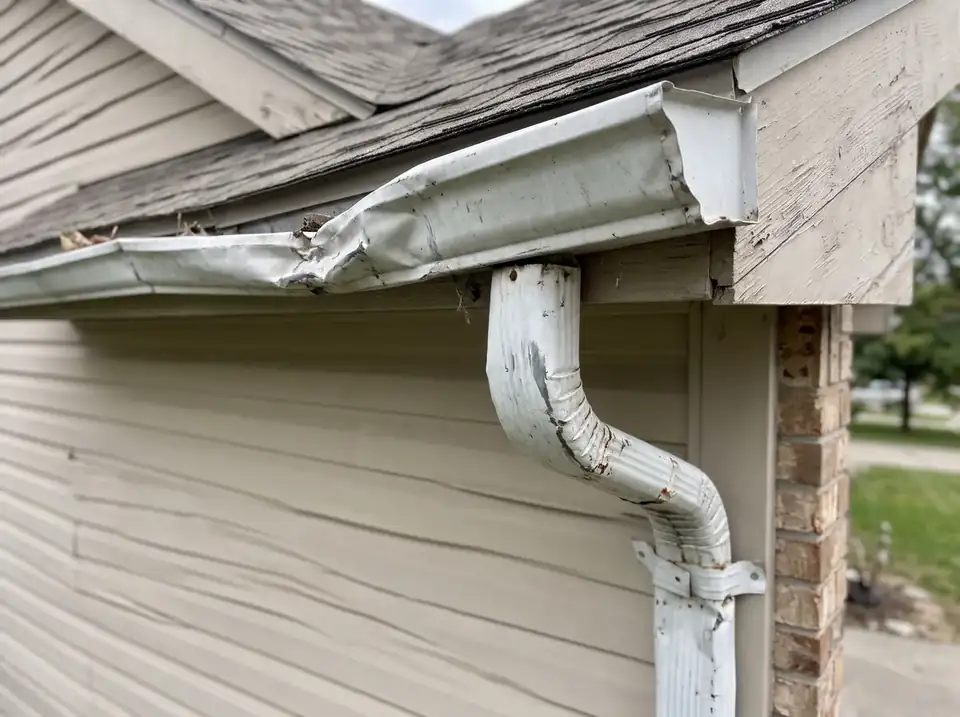
| Run bent or kinked | Limb, wind, ladder | Replace the section |
| Dents along the front lip | Hail, debris | Replace if drainage affected; cosmetic dents may stay |
| Downspout ripped from wall | Wind | New straps, replace bent sections |
| Corner split | Wind, impact | Replace and reseal corner |
| Sagging after snow or ice | Weight on long runs | Rehang, add hangers |
| Fascia cracked or crushed | Limb | Replace fascia, then rehang |
Which terms come up with storm repairs?
| Term | What it means on a Lafayette house |
|---|---|
| Hidden hanger | A bracket that hooks under the front lip and screws through the back of the gutter into the fascia, unseen from the yard. |
| Spike and ferrule | An older fixing: a long nail through a sleeve inside the gutter. Wind, weight and wood movement slowly lever it out of the board. |
| Gauge | Metal thickness. Residential aluminum gutter is usually .027 or .032 inch; the heavier coil shrugs off ladders, limbs and flying debris better. |
| Fascia | The board that caps the ends of the rafters. Every hanger bites into it, and in south Louisiana humidity a wet fascia softens fast. |
| Miter | The joint at a corner, cut, riveted and sealed. Corners carry the most water and are where most leaks start. |
| Downspout | The pipe that carries water from the gutter to the ground. 2x3 and 3x4 inch are standard; a 3x4 carries roughly twice as much. |
| Galvalume | Steel coated in an aluminum and zinc alloy, stiffer than aluminum and slower to dent, but it needs cut edges sealed in a humid climate. |
| Coil stock | The roll of factory-painted aluminum, steel or copper fed through the gutter machine. |
How is storm damage repaired?
- Inspect. The contractor checks every run, the fascia and the downspouts, not only the obvious damage.
- Make safe. Hanging sections are taken down.
- Repair wood. Cracked or soft fascia is replaced.
- Replace gutter. Damaged lengths are replaced with matching seamless runs where possible.
- Refasten. Hidden hangers about every 2 feet; heavier metal on exposed walls if you choose.
- Document. A written estimate and photos for your insurer if needed.
How do you make gutters more storm resistant?
| Upgrade | Why it helps |
|---|---|
| Hidden hangers every 2 feet into solid wood | Nothing for wind to lever out |
| .032 aluminum or Galvalume | Resists bending and denting |
| Downspout straps every few feet | Stops pipes being ripped away |
| Trimming limbs over the roof | Fewer impacts and less debris |
| Clean gutters before June | They drain tropical rain instead of overflowing |
The hurricane season guide has a full checklist.
What about storm-chasing contractors?
After big storms, out-of-area crews often arrive. Check any contractor before paying a deposit: ask for their Louisiana registration or license number, check it on the state board's search, and get a written quote.
Storm damage: quick answers
| Question people ask | Short answer |
|---|---|
| Should I wait for my adjuster before repairs? | Make the house safe, photograph, then follow your insurer's advice |
| Can I keep using a dented gutter? | If it drains and is secure, a short wait is fine |
| Are tarps on gutters a good idea? | No; keep tarps on the roof, not tied to gutters |
| Will new gutters match my old ones? | Usually, in common colors and profiles |
Where does storm damage come up around Acadiana?
| Town or neighborhood | Why it matters there |
|---|---|
| Abbeville | Measured 100 mph gust during Hurricane Lili |
| New Iberia | EF2 tornado in December 2022 |
| Rayne | EF2 tornado in March 2011 |
What is the one thing to do first?
Take wide photos first, then close-ups, all from the ground and with the date. Insurers and contractors both work faster from clear photos.